
Born in Milan and raised in Rho, Italy, Andrea Cosco was diagnosed with neurofibromatosis type 1 (NF1) shortly after birth. Because no one else in his family had the condition, his diagnosis was believed to be the result of a spontaneous genetic mutation.
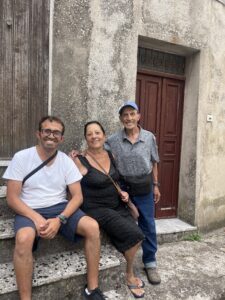 Andrea’s parents grew up in the small southern Italian town of Vincolise in the years following World War II. With limited educational opportunities and resources, they faced the challenge of understanding and navigating a complex and largely unknown condition while raising their young son.
“They did the best they could with the information they had,” Andrea shared. “There wasn’t much understanding of NF, and there weren’t many resources available.”
Seeking greater opportunity, Andrea’s parents later relocated to the Milan area, where they raised Andrea and his brother while working factory jobs. His father worked for Montecatini, a company whose history has since been linked to industrial chemical pollution in parts of Italy. While the exact cause of Andrea’s NF1 remains unknown, as is the case for many individuals diagnosed through spontaneous mutation, questions about environmental factors have remained part of his family’s story and understanding of the condition.
As a child, Andrea often felt different from his peers. Living with an optic pathway tumor caused one of his eyes to protrude significantly, making social interactions difficult and drawing unwanted attention. In 2011, after years of navigating the physical and emotional challenges associated with the tumor, he made the difficult decision to have the eye removed.
“It wasn’t an easy decision,” he said. “But it was one that ultimately helped me move forward.”
While visible symptoms presented challenges, many of Andrea’s struggles were less obvious. NF1 affects him in ways that many people cannot see, from chronic fatigue and balance issues to temperature sensitivity and physical limitations that impact his daily life. 
“People often don’t understand what living with NF is really like,” Andrea explained. “There are symptoms that don’t show up on scans or medical charts, but they affect how you move through the world every day.”
Despite those challenges, Andrea remained determined to build a future for himself.
After moving to Southern California, he pursued higher education and eventually earned a master’s degree in science. His personal experience with NF sparked a fascination with biology and medical research, leading him to study topics closely related to the condition that had shaped his life.
“When you grow up with NF, eventually you want to understand it,” he said. “I became curious about the science behind it.”
Although his career path didn’t ultimately lead him into NF research, Andrea spent more than a decade working in the biotechnology industry. During those years, he continually adapted to the physical demands of the workplace while proving, to both himself and others, that he was capable of succeeding.
“I was able to build a career, earn a promotion, and create a life for myself,” he said. “But there were also challenges that people didn’t always see.”
As his symptoms progressed, Andrea found himself facing difficult decisions about his future. Eventually, he stepped away from his role and began pursuing a new dream: becoming a teacher.
Today, he is completing his teaching credential program and preparing for the next chapter of his journey.
 “I’ve learned that sometimes you have to find a different path forward,” Andrea said. “You try ten things, maybe nine don’t work, but one does and that’s the one you keep building on.”
One of the most transformative parts of Andrea’s journey has been finding community through an NF support group affiliated with UCLA.
The group, which includes NF patients, nurses, psychologists, and medical professionals, provides a safe space for individuals to share their experiences, discuss challenges, and support one another.
For Andrea, the experience was life changing.
“For the longest time, I thought some of the things I experienced were unique to me,” he said. “Then I met other people with NF who said, ‘Me too.'”
Whether discussing treatment side effects, workplace challenges, mental health, or everyday obstacles, the group has helped Andrea realize that he is not alone.
“We listen to each other,” he said. “Sometimes that’s the most important thing.”
The support group has also reinforced something Andrea believes deeply: people living with NF deserves a stronger voice.
Throughout his life, he has encountered situations where others underestimated his abilities or made assumptions based on his appearance or physical limitations. While those experiences have been frustrating, they have also fueled his desire to advocate for greater understanding and awareness.
“I think people with NF spend a lot of time proving themselves,” Andrea reflected. “We want people to see what we’re capable of not just our diagnosis.”
That belief extends beyond awareness efforts and into research itself. Andrea hopes that researchers, healthcare providers, and organizations continue listening closely to patient experiences and recognizing that some of the most important insights come directly from those living with NF every day.
“There are things patients know because they live with this condition,” he said. “Those experiences matter.”
As he prepares to become an educator, Andrea hopes to continue sharing his story, connecting with other NF patients, and helping create a future where people living with NF feel seen, understood, and supported.
His message to others navigating their own NF journey is simple:
“Keep looking for solutions. Keep learning. Keep moving forward. You may have to find a different way to reach your goals, but that doesn’t mean you can’t reach them.”
Through resilience, curiosity, and a commitment to helping others, Andrea continues to show that while NF may be part of his story, it is far from the whole story.